
All about STEM
What is STEM? Updates, careers, and topics in STEM.

What is STEM?
By: Srimythri Grandhi
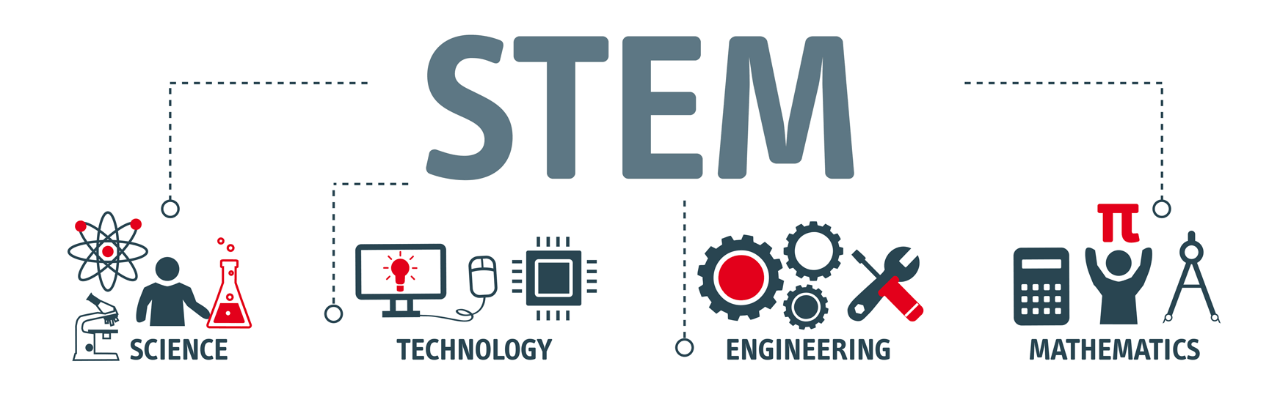
A phrase, "STEM," an ongoing term rising up the industries. What is STEM? THe acronym STEM stands for Science, Technology, Engineering, and Mathematics, a vast field of many careers and professions. As this field continues to grow day by day, it is crucial to understand what the STEM field is.
In the science aspect comes disciplines including chemistry, physics, environmental science, and biology. Here, students understand scientific concepts, utilize analytical skills to investigate questions, and delve upon data. They combine curiosity with scientific processes, tackling areas and issues such as climate change, ethical issues, and public health. This field often compasses theory and knowledge, vital for the foundation of STEM.
Next comes the technology aspect, one crucial to understand our day to day life as well as the future of STEM. This includes computers and software, systems and tools, and engineering computer science concepts. By devling on the technology advancements, individuals continue innovating in this field, transforming the world around them. They engage with various technologies, learning and experimenting in careers like information technology, cybersecurity, and artificial intelligence.
Engineering, another aspect of STEM, is the combination of scientific and mathematical theories to design, build, and structure machines and systems. This aspect consists of creativity, knowledge, and practical skills, all combined with creation and problem solving. By developing tools such as infrastructure in civil engineering and medical devices in biomedical engineering, they continue to improve the life around them through creation.
Finally is mathematics, often known as the language of STEM. This includes utilizing the fundamental mathematics to solve problems, analyze, and model. Often combined with engineering and science, mathematics allows the solving of complex concepts and understanding of qualitative and quantitative data. This is utilized to equip students with skills needed to tackle real world problems.
Cool Chemistry-Centered Careers
By: Shriaditi Kancherla
STEM is a huge topic, encompassing unique subjects and specialties. Within the “S”, or “Science” part of STEM, is Chemistry, which is the study of substances, their properties, and the processes they undergo. Chemistry is applicable in a variety of careers, let’s take a look at some of them!
Chemical Engineer:
A chemical engineer is a career that focuses on the production of materials/items that are done through chemical reactions (exothermic, endothermic reactions, things involving catalysts, etc). Chemical engineers work to create and develop processes and equipment that can improve the efficiency, sustainability, eco-friendliness, and cost effectiveness in production of items, waste, etc. Chemical engineers require a strong background in chemistry, physics, engineering, mathematics, and biology (in some specializations of chemical engineering). Chemical engineers require a bachelor’s degree and in some specific jobs a masters degree is required.
Forensic Chemist:
A forensic chemist analyzes evidence from crime scenes. They analyze physical evidence in labs such as blood, toxins, drugs, hair, and broken glass to aid law enforcement in understanding what happened during a crime. They can help determine, for example, if arson was committed, if an explosion was detonated, or if there is DNA from the victim on a suspected weapon. Forensic chemists need strong skills in chemistry, biology, genetics, forensics, and even materials science. Forensic chemists require a bachelor’s degree and a master’s degree in management or leadership positions.
Cosmetic Chemist:
A cosmetic chemist formulates and tests products used in the cosmetic industry, including skincare, haircare, and makeup. They work with ingredients like oils, emulsifiers, preservatives, and active compounds to create safe and effective beauty products. Cosmetic chemists ensure that formulations are stable, non-toxic, and perform as intended, whether for moisturizing, anti-aging, or improving the texture and appearance of hair and skin. They may also test for allergens or irritation, and ensure that products meet regulatory standards for safety and efficacy. Cosmetic chemists need a deep understanding of chemistry, biology, and dermatology. Cosmetic chemists require a bachelor’s degree, but many employers may require a masters or PhD.
Terrific Tech Careers
By: Shriaditi Kancherla
STEM is a huge topic, encompassing unique subjects and specialties. The “T”, or “Technology” part of STEM, likewise, is a wide field. Let’s take a look at some careers in technology!
Cybersecurity Analyst:
Cybersecurity analysts work to protect an organization’s information systems from cyber threats. They monitor for security breaches, conduct regular security assessments, and respond to potential security incidents. They also implement and develop protective measures like firewalls and encryption to protect sensitive information. Cybersecurity analysts require experience in IT security, encryption methods, and risk management. Cybersecurity analysts typically require at least a bachelor’s degree.
Software Engineer:
Software engineers design, develop, test, and maintain software applications across a variety of industries. They work with programming languages such as Python, Java, C++, to create systems and programs that can address issues and perform needed functions. They are also responsible for debugging and optimizing code to enhance efficiency. Software engineers typically require a strong foundation in computer science, problem-solving, and mathematics. Software engineers typically require a bachelor’s degree, and a masters for specialized or leadership roles.
Web Developer:
A web developer is a person who creates and maintains websites online. They utilize coding languages such as HTML, Python, and JavaScript to manage both the visual/UI (user interface) and data storage aspects of a website. Web developers try to create web pages that are optimized for best user experience/engagement, data storage, and speed. Web developers may not require a bachelor’s degree but rather strong technical skills and experience with web development and using languages such as HTML, CSS, and Python that can be gained through certification programs or bootcamps.
Current Future of STEM: Recent Breakthroughs
By: Srimythri Grandhi
A field, ever evolving and progressing, is the world of STEM where each day is the creation of a new innovation. With a vast platform, this field offers an arena of discovery, constantly modifying and adapting the industry one by one. From artificial intelligence to genetic engineering, each creation follows with a breakthrough. Here are some of the most recent STEM breakthroughs.
As artificial intelligence starts transforming the world, new introductions are made, increasing various field potentials. AI is now being used in other disciplines of physics, biology, chemistry, and environmental science to enhance research methodologies and increase discovery. By using high end AI technologies and codes, companies are not able to utilize this intelligence to expand discovery capabilities such as drug discovery and climate change challenges. These new models adopted by Microsoft and Google are able to perform complex tasks and enhance efficiency. Additionally, AI-driven robots are able to address medical needs such as constant patient care or precise help. One of Google's latest innovations includes Google DeepMind, whose AI can control the plasma inside a nuclear fusion reactor, increasing the stability of fusion processes and production of clean energy.
In the medical and biological science field, scientists have made a breakthrough by creating implantable patches of beating heart muscle, providing stability to organ contract. Through the fusion of programming techniques as well as biological knowledge, transplants with a potential to strengthen heart muscle and decrease chances of heart failure are now available. By replacing the injection of heart muscles, which often leads to a growth of tumors and irregular heartbeat, patches are able to regulate heart cells by providing more heart muscle cells yet no risks. Researchers tested this on various patients, finding clinical results of stability of patients, who are not surviving with adequate blood supply and heart health.
Another breakthrough of a collision between the artificial intelligence and biological fields includes artificial blood development. Experimenting with lab-grown red blood cells and synthetic substitutes, manufactured and prescribed blood is now being designed. Using synthetic nanoparticles mimicking the oxygen of red blood cells, the innovation hopes to create lab-grown blood, an artificial substitute for real blood. Though challenges arise on the efficiency of this innovation, such as the storage and stability of the artificial blood, this breakthrough continues to bring hope for easy blood transport, military care, and emergency medicine.
The Intersection of Tech and Medicine
By: Shriaditi Kancherla
In the field of STEM, it seems as if Technology and Medicine are disconnected topics. Technology focuses more on digital aspects, while medicine relates to the “S” of STEM, or Science! However, the rise of digital technologies has increasingly bridged the gap between these sectors. Let’s take a look at how technology can impact medicine!
Diagnostic Tools: AI-driven applications now analyze medical images—such as MRIs and mammograms—to identify abnormalities that the human eye can miss. For instance, AI algorithms assist in early cancer detection by evaluating medical scans using extensive data sets.
Telemedicine: The COVID-19 pandemic led to the mass adoption of telemedicine, allowing patients to consult healthcare providers remotely through digital platforms. This has made healthcare more accessible for those who may not be able to physically meet a doctor due to issues such as transportation, scheduling conflicts, or for those who live in remote areas.
Digital Health Tracking and Health Managment Tools: Wearable devices, such as smartwatches and fitness trackers, track and record vital signs like heart rate and activity levels. These tools enable patients to monitor signs throughout the day and address any issues proactively. With more advancements, these devices will become more efficient, cheap, and help monitor even more conditions. One example would be the Oura tracks over 20 health metrics, including heart rate, sleep quality, body temperature, and activity levels. An Oura ring noticed irregular data, which made them go to the doctor, where they received a cancer diagnosis. If they did not have a tool to notice this abnormality, their cancer diagnosis could have been later and therefore harder to treat.
Additionally, there are many apps and websites that help people manage their health and wellness. Fitness and nutrition apps are some common applications, but there are also apps to help provide therapy to insomnia patients.
The integration of technology and medicine is revolutionizing healthcare, offering improved diagnostics, accessible care, and personalized health management. As digital tools continue to evolve, they have the potential to change lives and positively impact the healthcare industry.
Statistics: Let’s Analyze this a Little More~
By: Shriaditi Kancherla
STEM is a huge topic, encompassing unique subjects and specialties. Within STEM is Statistics. Statistics is the science of collecting, analyzing, interpreting, presenting, and organizing data. It involves methods for summarizing and making inferences from data. Statistics helps us understand trends, relationships, and patterns, helping to understand and quantify uncertainty and variation in various contexts. Statistics is considered to be both a science and part of mathematics, essentially at the crossroads of the two core subjects. Statistics can be applied to various fields, including business, economics, medicine, government, and even education. Some careers in statistics include:
Statistician: Statisticians apply mathematical and statistical techniques to analyze and interpret data, helping solve real-world problems in business, engineering, healthcare, or other fields. They design surveys and experiments, collect and process data, and use statistical software to analyze results.
Data Scientist: Data scientists utilize advanced analytics technologies and scientific principles to extract insights from complex data sets. They combine computer science, statistics, and domain expertise to interpret large volumes of data, often employing machine learning algorithms.
Financial Analyst: Financial analysts evaluate financial data to assist businesses and individuals in making investment decisions. They analyze market trends, economic conditions, and company performance to provide recommendations on investments, budgeting, and financial planning. A background in statistics is crucial for assessing financial risks and returns.
Purdue University
Market Research Analyst: Market research analysts study market conditions to assess potential sales of products or services. They collect and analyze data about consumers and competitors, helping companies understand what products people want, who will buy them, and at what price.
Biostatistician: Biostatisticians apply statistics to the field of biology, particularly in health-related research. They design and analyze data from experiments and clinical trials, contributing to advancements in public health and medicine. This role often involves working with healthcare professionals to interpret data on disease outbreaks, treatment efficacy, and health trends.
Understanding Fin-Tech as a Field
By: Shriaditi Kancherla
The fin-tech industry is currently an up-and-coming industry and experiencing rapid growth. Fin-tech, or financial technology, integrates both technology and finance, essentially utilizing technology to make the finance industry more digitized.
Fintech encompasses a broad range of applications. For example, fintech has helped digitized banking, enabling individuals and businesses to conduct transactions through digital wallets, mobile payment apps, and online banking platforms. This enables users to transfer funds, pay bills, and manage their finances conveniently from their devices.
Another application of fintech is investing. Robo-advisors provide investing and financial planning services based on a client’s individual financial goals, their current portfolio, and industry trends.
Fintech has the potential to help a lot of people! Fintech has made online banking seamless and easier to use, making banking accessible to many underprivileged communities. Additionally, fintech and algorithm/AI-based tools can help businesses make proper financial decisions, manage their finances, transactions, and comply with state and federal regulations. Fintech is continuing to innovate and revolutionize financial services.